- Huawei P30 Hands-On
- Crucial MX500 1TB SATA Solid State Drive Review
- Intel’s flawed ‘Rangeley’ Atom C2000 processors are still a ticking time bomb
- Eric Broockman Extreme Networks CTO Interview
- Introducing the D-Link COBRA AC5300 Wave 2 MU-MIMO Wi-Fi Modem Router and Triple Band Wi-Fi explained
- VICHYPER - Australian Hyperloop Interview and Tour
- Kaspersky Keynote and Press Conference - Sydney 2017
- ZOTAC NVIDIA GeForce GTX 1050 Australian Review
- Intel Core i7 Extreme Edition (Codename: Broadwell-E) Processor Australian Review
- ASUS ROG GX700 Liquid Cooled Gaming Laptop Video Preview and Analysis.
- Video Tour - NitroWare experiences HP's new Australian Customer Experience Centre and Intel 6th Gen ‘Skylake’ PCs
- Bose SoundTouch 2015 Wireless Speaker Preview
- NVIDIA GeForce Experience Quarter 4 2015 Update Analysis
- NVIDIA GEFORCE GTX 980 Ti Australian Review - TITANic graphics performance for US $649
- HP Zvr 23.6-inch Virtual Reality Display First Look
- NVIDIA GeForce GTX TITAN X Video Card Australian Review
- Battlefield Hardline - Developer Q&A with Visceral Games
- The NVIDIA GEFORCE GTX 960 REVIEW - EVGA SSC Edition
- NVIDIA'S GEFORCE GTX 980 Apollo 11 Lunar Landing Tech Demo tested
- Monster Cable Premium Black 27.7 Gbps high bandwidth HDMI 2.0 cable test
- 4th Gen Intel Core "Devil's Canyon" Processor Family Preview
- Seagate Business 4-Bay 16TB NAS Review
- MSI Radeon R9 270X HAWK & GeForce GTX 760 HAWK Video Card Review
- Adobe Photoshop CC and AMD Radeon GPU Smart Sharpen Benchmark using OpenCL
- AMD Radeon R9 290X Video Card Review and Analysis
- Never Settle: Forever game bundle: What you need to know and what AMD could have done differently.
- Intel 4th Gen 'Haswell' real world gaming performance
- An Evening with Battlefield 4
- Intel 4th Gen Core i7-4770K 'Haswell' CPU Performance Review
- Our experience with AMD's Never Settle Reloaded game bundle - Trouble with Ubisoft Uplay | Updated
- Crucial MX500 1TB SATA Solid State Drive Review
- ZOTAC NVIDIA GeForce GTX 1050 Australian Review
- Intel Core i7 Extreme Edition (Codename: Broadwell-E) Processor Australian Review
- NVIDIA GEFORCE GTX 980 Ti Australian Review - TITANic graphics performance for US $649
- NVIDIA GeForce GTX TITAN X Video Card Australian Review
- The NVIDIA GEFORCE GTX 960 REVIEW - EVGA SSC Edition
- NVIDIA'S GEFORCE GTX 980 Apollo 11 Lunar Landing Tech Demo tested
- Monster Cable Premium Black 27.7 Gbps high bandwidth HDMI 2.0 cable test
- Seagate Business 4-Bay 16TB NAS Review
- MSI Radeon R9 270X HAWK & GeForce GTX 760 HAWK Video Card Review
- Adobe Photoshop CC and AMD Radeon GPU Smart Sharpen Benchmark using OpenCL
- AMD Radeon R9 290X Video Card Review and Analysis
- Intel 4th Gen 'Haswell' real world gaming performance
- Intel 4th Gen Core i7-4770K 'Haswell' CPU Performance Review
- Our experience with AMD's Never Settle Reloaded game bundle - Trouble with Ubisoft Uplay | Updated
- Huawei P30 Hands-On
- Introducing the D-Link COBRA AC5300 Wave 2 MU-MIMO Wi-Fi Modem Router and Triple Band Wi-Fi explained
- ASUS ROG GX700 Liquid Cooled Gaming Laptop Video Preview and Analysis.
- NVIDIA GeForce Experience Quarter 4 2015 Update Analysis
- HP Zvr 23.6-inch Virtual Reality Display First Look
- 4th Gen Intel Core "Devil's Canyon" Processor Family Preview
- Intel 4th Gen Core Haswell CPU and Graphics Preview - See the future of PC graphics through Intel's Iris.
- Cooler Master's Trigger keyboard might just be the perfect gamers keyboard
- ZOTAC "Inner-Beauty" Small Form Factor PC Preview featuring Z77-ITX WiFI and GeForce GTX 680 AMP! Edition
- Intel Desktop Board DX79TO Preview | Sandy Bridge-E performance on a budget
- Gigabyte GZ-X1 Mid Tower ATX Computer Case Preview
- Telstra Turbo 7 Series 3G Wireless Gateway - First Impressions
- Lian-Li Tyr PC-X2000 HTPC/Gaming Chassis Preview
- Intel’s flawed ‘Rangeley’ Atom C2000 processors are still a ticking time bomb
- Never Settle: Forever game bundle: What you need to know and what AMD could have done differently.
- Price Gouging – Australians pay up to twice as much for Microsoft Windows 7 Anytime Upgrade but not for Windows 8 than the US
- Intel CPU Protection Plan for overclockers – Ploy or Promise ?
- Where did all my printer ink go? Part 2 - Epson
- Where did all my printer ink go? Part 1 - Brother
- How to install Windows Server 2008 R2 or Windows 7 using a LSI 3ware 9650SE RAID card
- Issues with Realtek High Definition Audio device driver for Windows XP
- The front audio ports on my PC do not work – why is this and how can I fix this?
- How to create a dedicated Voice over IP headset for your PC - for free. Part 2.
- How to create a dedicated Voice over IP headset for your PC - for free. Part 1.
- Computer motherboard buyer guide - ECS X48T-A
- Making the most of dual onboard Ethernet ports
- How to fix IEEE 1394 FireWire Networking in Windows XP SP3
- DivX 6.5 crashing fix
- Eric Broockman Extreme Networks CTO Interview
- VICHYPER - Australian Hyperloop Interview and Tour
- Kaspersky Keynote and Press Conference - Sydney 2017
- Video Tour - NitroWare experiences HP's new Australian Customer Experience Centre and Intel 6th Gen ‘Skylake’ PCs
- Bose SoundTouch 2015 Wireless Speaker Preview
- Battlefield Hardline - Developer Q&A with Visceral Games
- An Evening with Battlefield 4
- CeBIT Australia 2012 Preview
- Trick or Treat – we bring you tech candy, err the latest Intel X79 Motherboards and other goodies
- Netgear introduces fully open-source Wireless-N Gigabit Router | Cebit Australia 2009
- Exclusive - Altec-Lansing shows off new speakers for 2009 at CeBIT Australia
- CeBIT Australia 2008 | Mtron claims to have worlds fastest Solid State Drive
- Sennheiser @ CeBIT Australia 2008
- Plantronics and Altec Lansing @ CeBIT Australia 2008
- Panasonic @ CeBIT Australia 2008
Events
Our staff regularly attend Expos, Trade Shows, Media Breifings and Product Launches relating to IT, Computing, Technology and Digital Entertainment industries.
In-Depth Coverage of these events is presented in our Events Category.
- Details
The ‘new’ Extreme Networks is the ultimate culmination of the enterprise networking divisions of several well established and significant telephony and networking brand names, mainly Extreme Networks, Brocade and Avaya with the ultimate goal to create a combined company aiming to be number 3 in the enterprise networking sector and a combined revenue of US $1bil.
To update users and partners on the new company and changes to products and support, Extreme did the typical world tour but with a difference.
Unusually for a large tech vendor, Chief Technical and Engineering Officer, Eric Broockman made himself available to said users and partners as a gesture of new company’s intention. The co-title ‘Engineering officer’ is unique, as a Chief Technical Officer is not necessarily an engineer or responsible for engineering. Eric told us that a typical day started with a small amount of ‘CTO’ work and the rest of the day was overseeing engineering and in this role he has been able to leverage his vast experience with other networking hardware vendors.
We sat down with Eric and chatted about future of networking from a wireless, wired and software perspective. Eric had some very interesting viewpoints on industry trends thanks to his unique position in the industry both as a CTO and a long time veteran of several networking and tech firms, even as a hairbrush salesman.
You do not need to be intimately familiar with Extreme/Brocade/Avaya products or enterprise networking to watch this interview but an understanding of networking topics and standards would be helpful.
Many of the topics discussed such as Wi-Fi AX, 2.5/5/10Gbit Ethernet, Virtualization and Open Source Networking/Security software are of interest to enthusiasts, power users and professionals.
00:25 Eric Broockman's technical and industry background
03:15 Combining the specialisations of Extreme, Brocade, Avaya and Zebra into the New Extreme Networks
05:20 Campus and Data center Networks explained
06:25 802.11ax Wi-Fi explained - Increasing density and improving reliability
09:25 Hardware versus Software in the Networking Industry and the ubiquitous 'single pane of glass' management concept
10:45 Free and open source software such as pfSense
13:50 Virtualisation - A new concept for Enterprise Networking devices such as Switches and Access Points
17:15 Lowering cost and increasing adoption of upcoming Ethernet Standards such as Nbase-T
20:20 Future Trends and where the Networking industry is going
Read on for our comments on the new company, the aquisitions involved as well as more detail on the future and emerging trends discussed.
- Details
Future transportation concepts, and more recently the ‘Hyperloop’ system proposed by Tesla/SpaceX can be highly controversial, risky and sometimes more of a publicity stunt to advance and promote research and development of a particular government or private enterprise.
‘Hyperloop’ itself is not a new idea by far, it is simply the brand name coined by the joint Tesla/SpaceX team to their implementation, and of those of which to be similar and compatible systems developed by other academic research teams in recent years.
The short of it is that ‘Hyperloop’ is a magnetically levitating train that travels within a vacuum tube instead of free air in order to avoid the resistance of friction
In the case we are reporting on today the train is simply a single passenger-less prototype/test vehicle.
VICHYPER is the student engineer team spun out of RMIT University Melbourne, backed by Australian and International global sponsors from the technology and transportation sectors. Competing in the SpaceX Hyperloop Pod Competition, VICHYPER's efforts were rewarded by being the only finalists from the Southern Hemisphere.
I had the opportunity to see their pod vehicle at CeBIT 2017 and interviewed one of the mechanical engineers on the project where we discussed the concept of maglev and vacuum transportation as well as the design and features of the vehicle and that interview is presented below.
We discuss how the vehicles systems work, the concept of a Hyperloop/vac train and engineering aspects behind the vehicle and system as a whole.
Remebering past 'future' transport research and concepts
While I am proud as an Australian to see the home team trying to beat the yanks at their own game, I have followed this subject personally for some time and I sure do have my own two cents plus tax on the matter.
Almost every form of advanced land transportation developed through the 20th century has failed to get past initial or prototype/demonstration phase. As I am writing this story I am struggling to think of any exceptions to this rule. High Speed Rail, which is conventional steel wheel-on-rail up to 200MPH/350KPH does not count as this is an evolution of conventional legacy technology.
Even if we look at air transportation, supersonic transport was a relative failure if we consider the costs required to run Concorde and its eventual tragic demise plus the epic failures of the Soviet Tu-144 ‘Concordski’ and American Boeing 2707 Super Sonic Transports.
The original objective of all these projects was to commoditise supersonic transport and as of 2017 this has failed to materialise, so we can consider all three a failure despite Concorde being able to turn around its financial woes in its final years.
Atomic powered aircraft also fits into this category, having never progressed past very early initial research stages by both the US Atomic Energy Commission/US Air Force with a converted B-36 Peacemaker bomber that carried an experimental nuclear reactor and the USSR who had a Tu-95 Bear similarly fitted. Nuclear powered Jet Engines were developed and tested by General Electric for the former before the entire program was cancelled.
Getting back down to earth. The 20th century has seen a variety of weird and wacky rail concept vehicles. We had a strange railcar which used a single wheel rather than two wheels on an axle, like a bicycle which self-balanced itself. Obviously this never took off.
In 1931, the German Schienenzeppelin acheived a world record for a petrol powered rail vehiche of 230KMH, which still stands to this day. Yes, the name of the vehicle is apt, given it looks like essentially a zepplin on rails with a BMW aircraft engine and un-protected propeller sticking out the back . Obviously, modern transport does not have large and fast spinning propellers near people for obvious reasons and this concept never took off.
Post World War II there were many land transport concepts which either never got off the drawing board or never materialised into sales other than a prototype/demonstrator vehicle.
Atomic powered trains were conceived but seemed too expensive and problematic in urban areas.
The 60s and 70s especially assisted with an aerospace boom and fuel crisis saw initial developments into alternate wheel on rail propulsion such as gas turbines vehicles, electric monorails, mag-lev and even rocket power.
Some cities have recently demolished their monorail systems, citing age of vehicles/spare parts, inflexibility and poor routing as excuses, despite other cities using the same systems successfully. Sydney, Australia is a guilty party to these claims. In such cases, monorails have been replaced with nothing or light/heavy rail systems.
Mono-Doh!
Some of the more wacky proposals where to dig tunnels through the surface of the earth emerging at some other point on the globe. Large tubular vehicles would carry passengers and cargo through this vacuum tubes with gravity assist and this was supposed to solve all the world’s long distance travel problems.
Nope.
Things got so desperate from a scientific research POV by the early 80s following the oil crisis of the 70s that experiments into modern steam locomotives were conducted. Stabilisation of the fuel market and developments in solid state technology such as Fuel Injection, Emissions control and Traction Control which enhanced fuel economy and performance negated this thinking very quickly
Of all these concepts, it was the European Maglev system which held the most promise to be affordable, green and fast transportation system the future for the citizens, systems promised on every continent. In reality only China built a system in 2004 that carries fare paying passengers to this day but required with heavy support from Germany and the manufacturer Siemens. The original maglev demonstration track in Emsland, Germany that was operational for almost 40yrs, named TransRapid has since been demolished earlier this decade finally cementing the concept as a market failure despite the world overall rail speed record still held by Japanese research maglev vehicle.
So I come full circle back to vac-train and Hyperloop. It’s a reimaging of an old vac train concept we mentioned above. ‘Reports on the internet’ indicate that SpaceX/Tesla test track is rusting away now that competitions have been concluded and even that was not a model of a real world setup.
There are too many environmental, regulatory and cost restrictions to bring a Hyperloop system to reality, but that doesn’t mean one should stop trying. The VICHYPER pod we discussed in this video is full of equipment and in no means possible can fit a person or cargo. The VICHYPER team even wound their own linear motors versus using ‘off the shelf’ parts. We are a long way from this stage, decades, and by then who knows what will happen by then.
At least this concept uses semi proven technology (linear motors, mag-lev) and from that provides a stable basis for ongoing research, other than some pie in the sky revolutionary tech which is still in a theoretical stage.
As far as Australia is concerned, a hyperloop, maglev or conventional High Speed Rail route let alone a network is not happening in the next 10 to 20 years. My lifetime, who knows. Stranger things have happened.
- Details
2017 has been a very eventful year for cyber security, especially when we consider the adventures of Kaspersky lab in the media.
During the second half of 2017, Kaspersky Lab was subject to heavy public criticism by US media outlets and US Government agencies alleging that the firm was involved with Russian intelligence services and that its anti-virus software used for espionage purposes.
Subsequently, the US government banned their software from federal use and Best Buy pulled the product from retail sale.
Kaspersky lab has denied these allegations claiming they were “baseless paranoia” and a “witch hunt”
These allegations further developed via WikiLeaks disclosure in November where it was claimed the CIA was using Kaspersky Lab as a scapegoat for covert cyber activities. In addition, at the same time MI6 raised suspicions as to why Kaspersky software was targeted to specific banking customers.
In a world of fake news, stories like these are a daily occurrence on the web and we have to take the good and the bad, analysing them based on merit and fact.
First-hand information and reporting on the party/company concerned can go some way to evaluating such claims.
Kaspersky lab CEO/Founder Eugene Kaspersky visited Sydney, Australia in May 2017 to give the keynote address at the CeBIT expo. Eugene’s talk focused on Key cyber security issues for critical infrastructure, covering operating systems, banks, IoT, SCADA, Power Grids, Transportation and financial services
Eugene himself and regional executives from Kaspersky Lab also participated in a press conference with Australian technology media addressing current security topics and developments at Kaspersky. Topics covered in this Q&A session range from IoT/Critical Infrastructure, AI, US Election Hacks, Ransomware, Government Regulation, State Sponsored/Professional Cyber-attacks, Cyber weapons and gangs, human factors in security and Australian government's attention to Critical Infrastructure security.
00:05 Defining Critical Infrastructure, IoT and Smart Grids
01:20 Future AI threat defence
02:40 Alleged Russian interference with US Election
04:30 Wannacry prevention and rise of Ransomware business
08:30 Government licensing and regulation for cyber security
10:40 Achieving immunity against cyber risks & Kaspersky OS for Network Devices
14:20 What mobile phone does Eugene Use/Phone OS Security
16:10 Government struggles with Cyber Security despite investments
17:15 business/industry vulnerability to state sponsored & professional cyber-attacks and attacks on Australia
23:00 Social issues of Cyber Gangs poaching young engineering talent and Industrial Hacking
26:00 Cyber Weapons and Government Cyber Divisions
26:50 Humans versus consumer product security
29:50 Aust. Govt on critical infrastructure security
- Details
 HP have opened a dedicated showroom and meeting space in the heart of Melbourne, Australia to allow customers, end users and partners to experience the entire range of HP PCs, Printers, Peripherals and Heritage as well as the ability to meet, collaborate and do business.
NitroWare toured the new facility and previewed the brand’s new sleek Intel 6th Generation Core 'Skylake' based Notebooks, Convertibles, All in One Pcs, Business PCs and Laser Printers which incorporate HP's new design language of designing premium products that are equally suited for the home as they are for business.
In the Printing space HP is touting what they claim is a revolutionary change in print and toner technology called Jet Intelligence, which re-engineers the way toner is formulated for largely the first time in 30 years.
In this article we present our video tour of the facility as well as demonstrations of the new PCs and Printers.
- Details
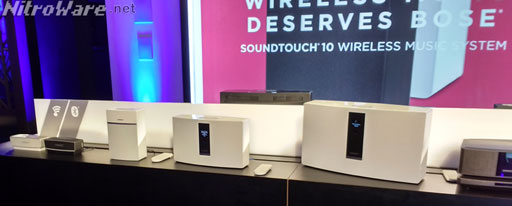 Bose's 2015 SoundTouch speakers offer internet music streaming connectivity, precision audio design and ease of use. With the compact SoundTouch 10, Bose is trying to appeal to an audience who may be new to the brand. Does Bose's efforts warrant your hard earned money? We discuss this in a preview of these new speakers.